
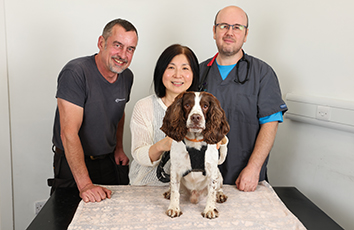
A MUCH-loved family pet who came close to losing his life after suffering a severe lungworm infection has made a remarkable recovery – prompting vets to urge dog owners to keep up to date with preventative worming treatment.
Quentin, a seven-year-old Sprocker Spaniel, was rushed to Chantry Vets’ Veterinary Hospital in Brindley Way, Wakefield, after developing a persistent cough that suddenly worsened, causing him to bring up blood. What initially appeared to be a possible grass seed lodged in his lungs quickly developed into a life-threatening emergency that required intensive round-the-clock care.
 Clinical Director Fraser Reddick, who led Quentin’s treatment after he was admitted to the hospital, said the case highlighted how dangerous lungworm can be and why prevention is so important.
Quentin had experienced several episodes of coughing since April, which had improved with treatment at Chantry Vets, which is part of VetPartners. However, concerned owners Rieko and Mark Gibson, who live in Sandal, Wakefield, took him back to Chantry Vets on July 7th after he started coughing up blood and the veterinary team knew further investigation was needed.
Blood tests showed signs of inflammation, and because grass seeds are a common cause of lung problems in spaniels during the summer months, Quentin underwent a CT scan which revealed widespread bleeding throughout his lungs but no foreign body.
Potentially fatal parasite caused Quentin’s illness
Suspecting lungworm, the team carried out further tests which indicated the potentially fatal parasite was the cause. Laboratory testing later confirmed the diagnosis.
Quentin required intensive care to give him the best possible chance of survival. He received a blood transfusion from one of the practice team’s own dogs to replace vital clotting factors and platelets, medication to help control the bleeding, steroids to reduce inflammation and minimise reactions as the parasites were killed, and treatment to eliminate the lungworms.
He remained under a light anaesthetic overnight while the medications took effect, with the hospital’s dedicated night team providing continuous monitoring and critical care.
The following morning was the most uncertain point in Quentin’s treatment as the team needed to determine whether he could breathe without intensive support.
Thankfully, Quentin gradually began to stabilise before continuing to improve over the following days. He will continue receiving treatment to ensure all the parasites have been eliminated and will remain on regular preventative worming medication to prevent the disease returning.
 Fraser said: “Quentin was an incredibly sick dog and there was a point where we genuinely didn’t know whether he would survive. Cases like this require rapid diagnosis, advanced imaging, intensive nursing care and a huge team effort. Our in-house CT facilities, experienced clinicians and dedicated night team all played a vital role in giving Quentin the best possible chance.
Lungworm is now found throughout the UK
“Lungworm was once considered mainly a problem in the South of England and Wales, but it is now found throughout the UK. Although we don’t see large numbers of cases locally, Quentin’s experience shows it is present in our area and that every dog could potentially be at risk.
“The good news is that lungworm is largely avoidable. Using an appropriate preventative worming treatment, as recommended by your veterinary practice, is the best way to protect your dog from this potentially fatal disease.”
Quentin’s owners admitted they had been unaware of how serious lungworm could be before their beloved pet became ill and have echoed calls for owners to make sure preventative healthcare is up to date.
Mark, who runs motorcycle company Seven Seas Motors, said: “We had no idea lungworm could make a dog so critically ill. Seeing Quentin fighting for his life was terrible and we were distraught, but the care he received was incredible. We’ve been sharing his story because so many people have told us they didn’t know about lungworm either. If Quentin’s experience encourages even one owner to keep up with regular worming treatment, then something positive will have come from it.”
What is lungworm?
Lungworm is caused by the parasite Angiostrongylus vasorum, which affects the heart and lungs of dogs. Foxes act as a natural reservoir for the parasite, while slugs and snails carry the infective larvae. Dogs become infected by accidentally swallowing slugs or snails, or by coming into contact with slime left behind on grass, toys, water bowls or other outdoor objects.
Symptoms can include:
- Persistent coughing
- Breathing difficulties
- Lethargy
- Reduced appetite
- Weight loss
- Bleeding or bruising caused by problems with blood clotting
Without prompt treatment, lungworm can be fatal. Chantry Vets is encouraging owners to speak to their practice about the most appropriate preventative parasite treatment for their dog. Regular preventative worming is the simplest and most effective way to protect dogs from this potentially life-threatening disease.
For media enquiries, contact Amanda Little, PR and Communications Director: [email protected] or 07970 198492