
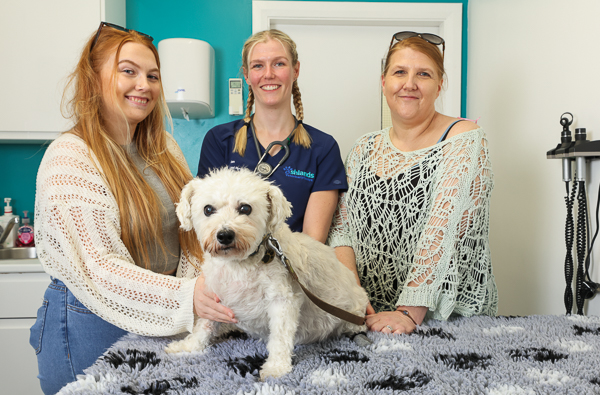
ASHLANDS Vets in West Yorkshire is warning pet owners to be extra vigilant about keeping dogs away from food waste after a much-loved family pet nearly died.
A cheeky dog’s raid on the kitchen bin nearly proved fatal and resulted in him needing round-the-clock care from the team at Ashlands Vets, which has practices in Skipton, Ilkley and Glusburn and is part of VetPartners.
Thirteen-year-old crossbreed Benji, who lives with owner Amanda Belt and daughter Katelyn in Skipton, was rushed to the Skipton practice after his owners discovered he had eaten some of the contents of their kitchen bin, including food that had started to ferment.
It’s not the first time he has eaten something he shouldn’t, leading to safeguards such as a wooden safety gate being put in place – but the determined pooch smashed through the gate to get to the scraps of food.
What initially appeared to be a straightforward case quickly escalated into a critical emergency, with Benji deteriorating rapidly after arriving at the practice at Rock Villa, Skipton.
Bloat can be fatal if not treated immediately
Vet Ryan Newman discovered that fermenting food inside Benji’s stomach was producing large volumes of gas, causing his stomach to expand dramatically and place dangerous pressure on his internal organs and major blood vessels. The condition, known as bloat, can be fatal if not treated immediately.
Ryan said: “When Benji first arrived, he appeared relatively stable, but he deteriorated very quickly. The fermenting food in his stomach was releasing a significant amount of gas, causing his stomach to become massively enlarged.
“This was putting pressure on major blood vessels and preventing blood from circulating properly around his body. His condition became life-threatening as his heart rate increased dramatically and his circulation began to collapse.”
The swollen stomach also put Benji at risk of developing Gastric Dilatation and Volvulus (GDV), a devastating condition where the stomach twists on itself, cutting off its own blood supply and often proving fatal without emergency surgery.
Recognising the seriousness of the situation, the Ashlands team immediately launched an intensive emergency response.
Veterinary nurses Niketa Thorpe and Sam Shillingford worked alongside Ryan and vet Ruth Auchterlounie to provide rapid fluid resuscitation and continuous monitoring.
Despite attempts to relieve the pressure using a stomach tube, only gas could be removed, leading the team to take the decision to perform a general anaesthetic and gastric lavage – a procedure used to wash out the contents of the stomach and remove potentially toxic material.
They were then able to administer activated charcoal to help absorb any remaining toxins.
Following the emergency treatment, Benji was transferred to Ashlands’ state-of-the-art veterinary hospital in Ilkley, where he received overnight monitoring and regular checks from the nursing team.
The Ashlands team were amazing
Thankfully, after spending one night in hospital, he made a full recovery and is now back to his normal self.
Benji’s relieved owner Amanda said: “The team at Ashlands were amazing. Everyone was so kind and caring, from the receptionist, who gave me a reassuring hug, to the vets and nurses who all went above and beyond to save Benji.
“Benji is very food-orientated, and within a short time after eating the contents of the bin he became unwell and was retching. I took immediate advice from my daughter who has a degree in animal science and is currently studying towards a Masters in Veterinary Physiotherapy, and we decided together that although we didn’t know exactly it was he had actually eaten from the bin we should contact the vets, who told us to take Benji down immediately.
“It was terrifying to see him deteriorate so quickly in the vets surgery, but the Ashlands team showed such compassion and took incredible care of him throughout. I’ll always be grateful for everything they did to save him.”
The case highlights the dangers that everyday household foods can pose to dogs. Many common foods, including grapes, chocolate, onions and products containing xylitol can be highly toxic to pets. Mouldy and fermenting foods can be particularly dangerous, potentially causing neurological problems, liver damage and severe gastrointestinal complications.
Ryan added: “We see dogs eating things they shouldn’t quite regularly, but cases involving severe bloat are always extremely serious. If owners suspect their pet has eaten something potentially harmful, it’s important to seek veterinary advice immediately. Warning signs can include vomiting, changes in appetite, increased thirst, lethargy, discomfort or changes in toilet habits.
“The sooner treatment begins, the better the chances of a positive outcome.”
For media enquiries, contact Amanda Little, PR and Communications Director: [email protected] or 07970 198492