
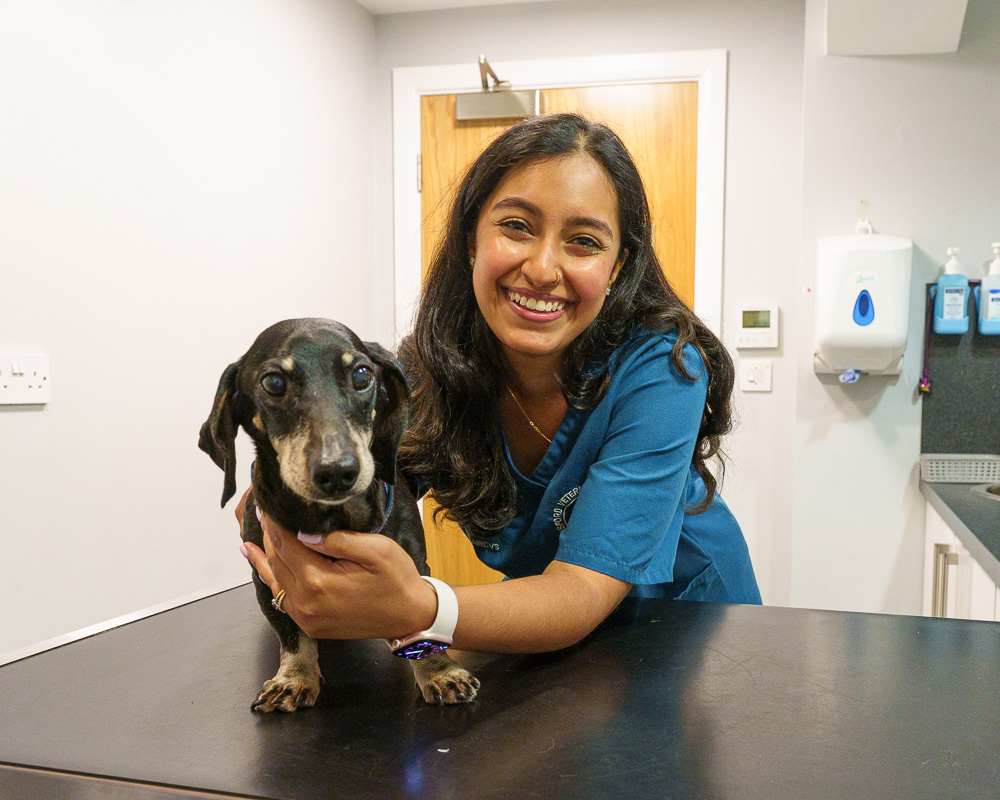
A CHESHIRE pet owner has praised vets who saved her beloved dog after it suffered from the life-threatening condition bloat.
Slinky, an 11-year-old Dachshund was rushed to Winsford Veterinary Surgery when his stomach became swollen and hard, leaving him whimpering in pain.
Thanks to the care and expertise of the vet practice in Winsford High Street, which is part of VetPartners, Slinky has made a full recovery. Now, the veterinary team and Slinky’s owner have joined forces to raise awareness of bloat and warn other dog owners to be alert to the signs.
Bloat, which is also known as gastric dilatation-volvulus (GDV), is a condition where the stomach fills with gas, and sometimes fluid or food, and becomes blocked. It is life threatening because the gas in the stomach puts pressure on blood vessels, restricting blood flow around the body, including to vital organs including the heart, and bacteria can also leak into the blood stream. An added complication is that the stomach can twist, cutting off its blood supply.
Signs of bloat include a distended stomach, retching or vomiting, salivating, excessive panting and struggling to breathe, discomfort and lethargy.
Vet Kajal Chopra, who treated Slinky, says time is of the essence with bloat and, if Slinky’s owners hadn’t acted fast, the outcome could have been very different for the pet.
When Slinky arrived at the practice his stomach was distended and very hard to the touch, and his heart rate was shifting between high and low, putting him at risk of a cardiac arrest.
Kajal said: “Bloat can be fatal within hours, and Slinky is very lucky that his owners brought him to us so quickly. They were so worried about him they brought their initial appointment forward by two hours, and that helped save his life.
“Due to the signs he was showing, we immediately suspected bloat and then confirmed this by taking X-rays. After anaesthetising Slinky, we had to decompress his stomach by inserting a needle to let some of the air escape, then we were able to gently place a tube through his mouth and down into his stomach to remove the build-up of fluid and food matter.
“He was immediately more comfortable, but we had concerns that Slinky’s stomach could twist. After discussing the options with the owner, they agreed for us to perform a procedure called a gastropexy, which involves stitching the stomach to the wall of his abdomen to hold Slinky’s stomach in place so it couldn’t twist or rotate. We’re very pleased that Slinky has gone on to make a good recovery and he was able to go home the following day.”
Kajal added that it is very unusual to see bloat in such a small dog and it is more commonly seen in larger and deep chested dogs, such as German Shepherds, Great Danes and St Bernards. Causes can include eating large meals too quickly, doing a lot of exercise after eating or stress.
Kajal said: “It’s quite rare for a small dog to have bloat, but Dachshunds do have quite deep chests, which means there’s room for the stomach to twist if it fills with gas.”
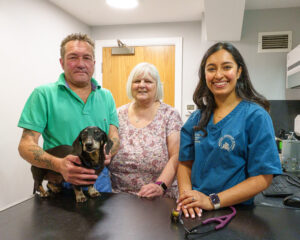 Slinky is now back home in Moulton and owner Angela McConnell has praised the Winsford Vets team for saving her pet. Angela rehomed Slinky two years ago, when he was nine years old, after his owner sadly passed away.
She said she was out visiting her mum when her partner, Carl Mottershead, called her to say he was worried about Slinky. She made an afternoon appointment with Winsford Vets, but when she got home, Slinky had deteriorated and she made the decision to take him in straight away.
Angela said: “I’m so grateful to Kajal and the team for saving Slinky’s life and I’m just so relieved we got him to the vets when we did. They gave him the very best care and they looked after us, too, making sure we understood what was happening and keeping us informed. I did have the option of not doing the surgery, but I didn’t want to take the risk of Slinky being dangerously ill again.
“I’m not sure what caused the bloat, but Slinky does have a habit of wolfing down his food, and I had already bought him a bowl that’s designed to slow down eating. Since his surgery, I’m putting out less food at a time, so he can’t eat too much at once, and that seems to be working well.
“I had heard of bloat before, but only that it affects sheep, and I didn’t realise dogs could get it as well. I’m hoping that by sharing Slinky’s story I can make other owners aware of the condition and let them know that if they see any of these signs in their dog, they should act fast, as it could save another life.”
Winsford Veterinary Practice delivers the highest level of care to patients and has a friendly team of vets, nurses and receptionists who are dedicated to giving clients and their pets the best possible experience when visiting the vets.
Article by Jo Browne, PR & Communications manager (South), email: [email protected]