
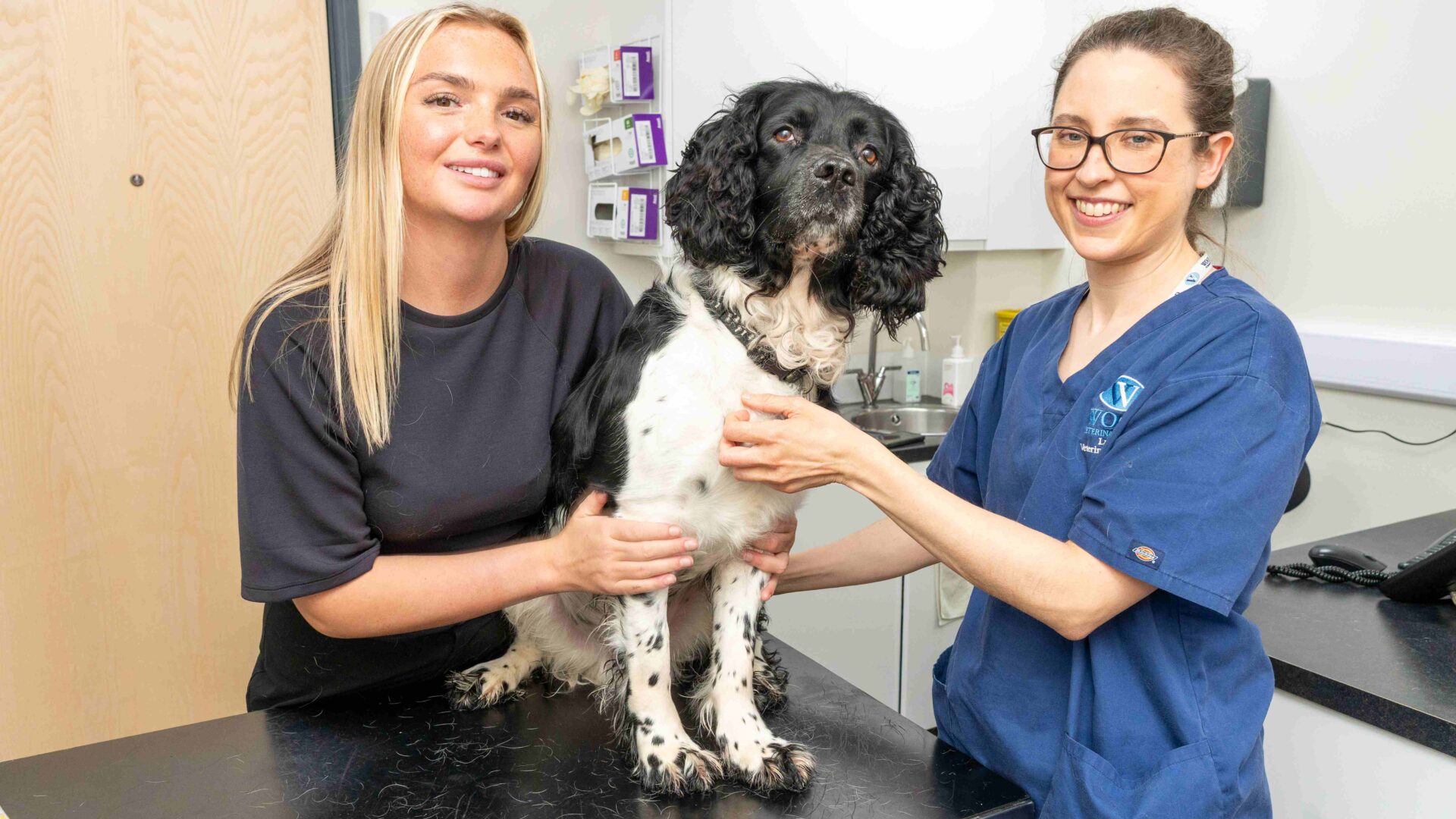
A GLOUCESTER veterinary practice is urging dog owners to take care when choosing treats for their pets after a Spaniel needed emergency surgery to remove a pig’s trotter from his throat.
Seven-year-old Springer Spaniel Humphrey was rushed to Wood Vets veterinary hospital in Quedgeley by his worried owners when he started being sick after eating and stopped passing faeces.
The pet was seen straight away at the practice, which is part of the VetPartners group, and an
X-ray revealed he had a pig’s trotter wedged in his oesophagus.
The much-loved pet had been given the flesh-covered bone as a treat but having eaten it, it then caused a life-threatening blockage.
Thanks to the care delivered by Wood Vets and his owners, Humphrey has made a full recovery. However, the veterinary team and his owners have joined forces to issue a warning about the dangers of giving pig’s trotters and other types of bone to dogs.
Vet Lucy Saye, who treated Humphrey, said he needed emergency surgery because the pig’s trotter was firmly stuck between the oesophagus and the entrance to his stomach. An attempt to bring it out the way it went down hadn’t been successful because it was so large and tightly wedged.
Lucy said: “The surgery was challenging because the pig’s trotter was inside Humphrey’s chest, at the base of his heart. To access the oesophagus though the chest and so close to the heart is a major procedure with additional risks. Instead, I made an incision into his abdominal cavity and then into the stomach. I was then able to reach through the cardiac sphincter that separates the oesophagus from the stomach and pulled the pig’s trotter out through the stomach.
“Humphrey is lucky that his owners acted quickly and brought him to us when they did, because if the pig’s trotter hadn’t been removed it would have been life-threatening. Food couldn’t reach his stomach and the bone would have caused the oesophagus to rupture.”
Once the offending pig’s trotter was removed, Humphrey spent a week at Wood Vets, where he was nursed around the clock and fed through a feeding tube because of the damage the bone had caused to his oesophagus.
Lucy added: “The pig’s trotter caused Humphrey a lot of issues and he was very poorly for a few days. He couldn’t eat normally for a week because the food would have irritated the damaged lining of the oesophagus and put him at risk of an infection. However, we’re delighted that he’s now fully recovered.
“As Humphrey has shown, pig’s trotters can be dangerous to feed to dogs and I would urge owners to choose treats for their pets wisely. If you want to give your dog a treat, a good idea is to keep back some of their daily ration of kibble and use this instead.
“As well as avoiding pig’s trotters and ears, never feed bones to your dog because they can fracture teeth or splinter and perforate the intestines. Rawhide chews can also cause issues because they are not easy to swallow and can get stuck in the teeth or parts of the gastrointestinal system. We would also advise avoiding treats that are high in sugar or salt.”
Humphrey is now back home in Gloucester with his owners the O’Leary family, who praised the team at Wood Vets for saving their pet.
The family often bought pig’s trotters from a pet shop as a treat for Humphrey and their other dog Harper but will avoid giving them the bones again.
Hettie O’Leary said: “It’s shocking how poorly Humphrey was because of the pig’s trotter and we really thought we were going to lose him. We are so grateful to Wood Vets for saving him. They gave him the best possible care and everyone at the vets was really invested in helping him recover. We also really appreciated the regular updates they sent us while Humphrey was at the hospital.
“We had no idea that the trotter had lodged itself until he started being unwell and at first we thought he might have a tummy upset. We’re so glad we took him to the vets when we did. We won’t be giving the dogs pig’s trotters or any bones in the future andI would urge other owners to avoid them too, because we’d hate anyone else’s pet to go through this.”
Wood Vets prides itself on offering the highest levels of care to pets at its 24-hour, fully equipped veterinary hospital in Quedgeley and its branch surgery in Longlevens. It is part of VetPartners, a group led by vets which has veterinary practices and animal healthcare businesses across the UK and Europe.
Article by Jo Browne, PR & Communications manager (South), email: [email protected]